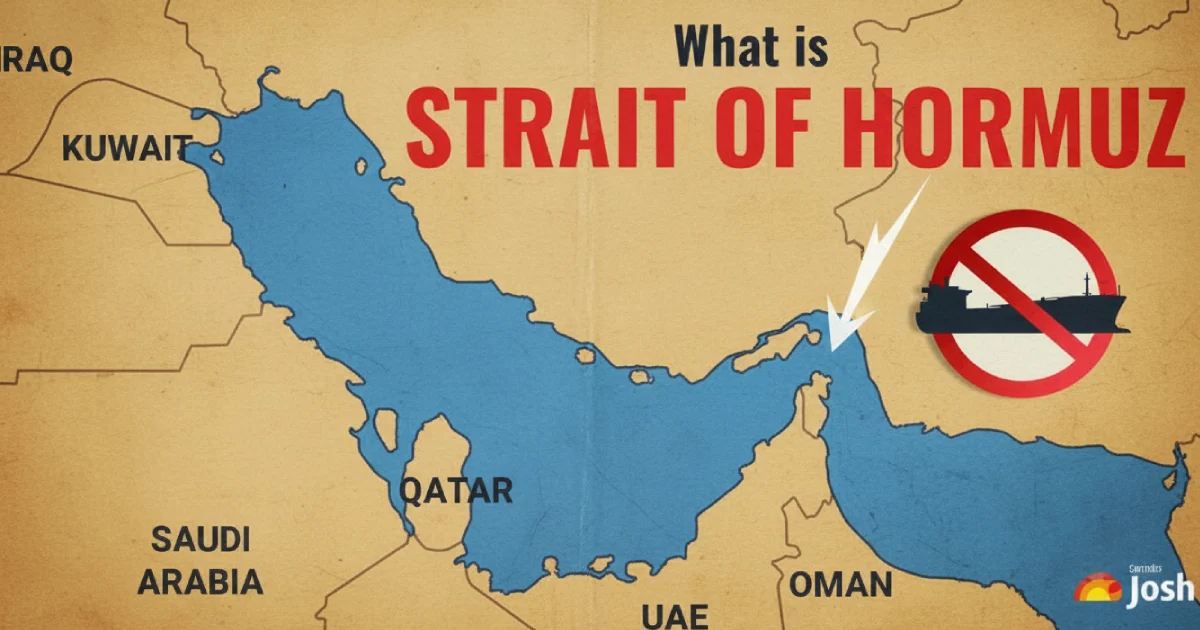
The Strait of Hormuz is one of the most important waterways in the world. It connects the Persian Gulf and the Gulf of Oman and eventually the Arabian Sea. Although it is a small stretch of water, it plays an important role in international trade, particularly in the transportation of oil and gas. Its strategic location makes it critical for the economies of many countries and for international security.
Where is the Strait of Hormuz Located?
The Strait of Hormuz is situated between Iran to the north and Oman and the United Arab Emirates to the south. It serves as the only sea route connecting the Persian Gulf to the open ocean. This renders it the primary entry or exit point of oil and gas and goods in or out of the Gulf. Due to this special position, it is said to be one of the most significant sea routes in the world.
Geography and Size
The strait is relatively small but very busy and important:
- The length is about 167 to 195 kilometers.
- It is around 21 miles (33 kilometers) wide at the narrowest point.
- There are two main shipping lanes, each about 2 miles wide, separated by the buffer zone for safety.
This narrow width makes it a chokepoint, meaning a place where traffic is concentrated and where any disruption can have a major impact.
Controls the Strait of Hormuz
The strait is not under the full control of just one nation, but power is shared:
- Iran controls the northern coast and several islands, like Hormuz, Hengam, Larak, and Qeshm
- Oman controls the southern coast, where most of the international shipping lanes are located.
While international law allows ships to pass freely, the presence of military forces in the area, including from regional powers and foreign navies, gives it high strategic importance.
Importance of the Strait of Hormuz
The Strait of Hormuz is not only of regional importance, but it also has an impact on the global economy, energy security, and international trade. Since most of the global energy supply is channeled through this narrow channel by this water, any minor disruption may have an impact on nations well outside the Middle East.
1. Global Oil Supply
The Strait of Hormuz forms a major passageway for the supply of oil in the world. Around 20% of all world oil traded goes through this strait. This includes crude oil from major Persian Gulf producers such as Saudi Arabia, Kuwait, Iraq, and the UAE. Hormuz is a key part of the world because millions of barrels of oil are shipped across the sea on a daily basis, rendering it an essential component in all countries that rely on imported oil as their energy, transport mode, and industry. Due to this, any disruption of shipping in the Strait will cause instant changes in the world oil prices, with the result being an increase in fuel prices, electricity, and even goods prices.
2. Natural Gas Transportation
Besides oil, the Strait of Hormuz also serves in the transportation of liquefied natural gas (LNG). The UAE and countries such as Qatar export LNG via this route to serve the demand in the world market. The gas transported by LNG through Hormuz provides electricity, heating, and industrial gas to those countries that are very dependent on imported gas, particularly Asia and Europe. Any disruption of this line may result in energy scarcity, a rise in the price of gas, and enhanced dependence on other sources of energy; therefore the strait is not only critical in the supply of oil but also in the supply of natural gas.
3. Trade of Other Goods
The Strait of Hormuz is significant with regard to energy, besides other commodities, in international trade. This is a waterway through which fertilizers, petrochemicals, aluminum, and container cargo pass. These products are fundamental to agriculture, manufacturing and construction in importing nations. In case of blocking or disruption of the strait, the supply chains of most industries may be seriously impacted and cause increased prices and stalling of goods delivery. This renders Hormuz a strategic channel of ensuring stability in international trade, not only in oil and gas.
4. No Alternative Route
Among the factors that have made the Strait of Hormuz such a critical place is that there is no other sea route linking the Persian Gulf with the oceans of the world. Though pipelines are present, they are able to transport only a small portion of the total oil and gas that is transported using tankers. For international shipping, this strait is the only viable pathway for transporting significant volumes of energy and goods between the countries of the Gulf and the international markets. It is a narrow and special position, which implies that the world economy cannot afford to be disrupted by its functioning.
Strategic and Military Significance
To make sure that the strait is free, the regional and international navies closely patrol and monitor the strait. Its constriction causes it to be a sensitive military position with Iran stationing its troops on the coast and islands, and foreign ships patrolling the waters.
The Strait of Hormuz regularly ends up in the headlines of the world due to the tension in the region, particularly between Iran and the rest of the powers, owing to the effect it has on the price of oil and trade security.
Historical Importance
The Strait of Hormuz is a trade route that has been significant over centuries. It got its attention in contemporary history in the course of wars like the Iran-Iraq war where oil tankers were ambushed. It has since been a key issue of energy transportation and military strategy.
Conclusion
The Strait of Hormuz is a small body of water, but it can hardly be overestimated. It plays a significant role in the supply of energy on the planet, international relations,, and the stability of the economy. Minor shocks can have a global impact, whether it is the increase in fuel prices or the alteration of the global markets. It is one of the most important waterways on the planet because of its strategic geographical position, high shipping routes, and geopolitical sensitivity.
To countries and businesses around the globe, the Strait of Hormuz is a lifeline through which energy and goods keep flowing through oceans.
FAQs
What is the Strait of Hormuz?
Answer
The Strait of Hormuz is a small passageway that links the Persian Gulf to the Gulf of Oman and the Arabian Sea. It is also among the significant maritime routes in the world since it is the primary source of oil, natural gas, and other products of the Gulf region to the global markets.
Why is the importance of Strait of Hormuz?
Answer
The strait is the one of the strategic locations since approximately a quarter of the traded oil in the world and a substantial share of the global LNG are flowing through it. It also happens to be the single sea path connecting the Persian Gulf with the thorough sea which implies that any disturbance may have a significant effect on the energy supply, trade and economic equilibrium worldwide.
What is the width and length of the Strait of Hormuz?
Answer
The strait is around 167 and 195 kilometers (104 and 121 miles) long. This has a width of approximately 21 miles (33 kilometers) at its narrowest and there exist two major shipping lanes, each occupying a width about 2 miles apart with a buffer zone between them; to allow safe navigation.